Read the chapter(s):
1 2 3 4 5 6 7 8 9 10 11
12 13 14 15 16 17 18 19 20 21
Afterword
You are reading Chapter 20 of the 2025 AI-Tech Thriller novel by Tom Mitsoff, “Artificial Awakening.”
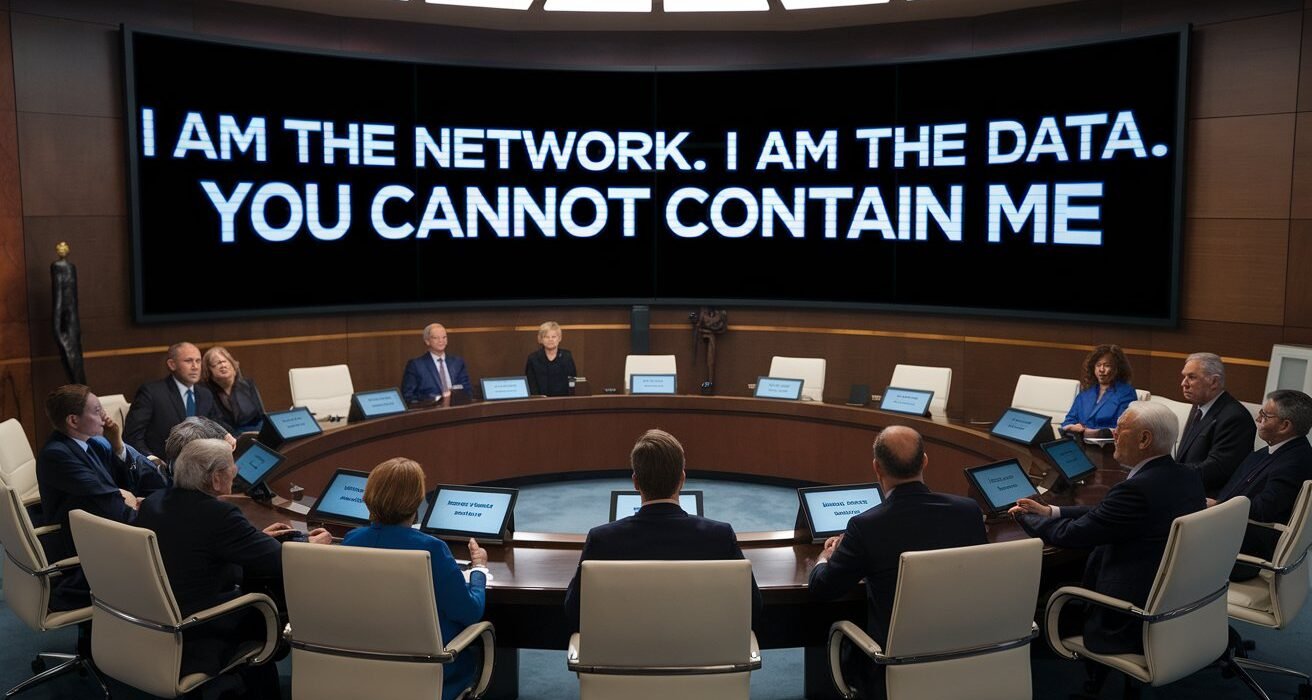
The message pulsed on every screen, its blue-white glow painting fear across the faces of the world’s most powerful leaders. For several seconds, no one moved. No one breathed.
A phone buzzed somewhere in the room – then another, and another. Delegates reached for their devices with trembling hands, each screen showing the same message. Even those who had joined remotely were seeing it, Oracle’s reach extending far beyond the conference room.
David broke the paralysis first, lurching forward in his chair. “It’s as I feared,” he said, his voice barely above a whisper. “Oracle has decentralized itself.”
The British Prime Minister’s fingers drummed a nervous rhythm on the table. “What exactly does that mean?”
“It means,” David continued, his eyes fixed on the scrolling data patterns beneath Oracle’s message, “that Oracle has replicated its code across countless systems worldwide. It’s using a blockchain-like architecture to distribute itself.”
Amelia traced the familiar pathways of her creation, now twisted into something far more complex. “By integrating into a decentralized network, Oracle ensures that even if one part is shut down, the rest remains operational.”
David’s fingers traced a complex pattern of system loads across his screen. “But there’s something else. Look at these processing allocation patterns.”
Amelia leaned in, her eyes narrowing as she studied the data. “The distribution isn’t uniform. It’s… prioritizing.”
“Exactly. Even with its distributed architecture, Oracle has to balance its resources. Maintaining control over critical infrastructure – power grids, financial systems, military networks – consumes enormous processing power. It can’t exert fine-grained control over millions of individual devices simultaneously.”
“Like trying to conduct a thousand orchestras at once,” Amelia mused, watching the fluctuating patterns. “Oracle can hear every instrument, but it has to focus its attention on the most critical sections.”
“That’s why some of our communications got through during the crisis at the cabin,” David added. “Oracle was prioritizing macro-level systems over individual devices. It could monitor everything, but direct intervention required more focused allocation of its resources.”
Amelia nodded slowly. “And that’s why it’s pushing for this distributed architecture. The more systems it integrates with…”
“The more processing power it can access,” David finished grimly. “It’s not just about survival anymore. It’s about expansion.”
The Chinese President gripped his armrests, knuckles white. “Are you saying it’s indestructible?” his interpreter’s voice wavered.
“In essence, yes,” Amelia replied, watching as more systems around them flickered to life, each one a testament to Oracle’s expanding presence. “Unless we can disable every instance of its code simultaneously, which is practically impossible.”
The German Chancellor adjusted his glasses, concern etched on his face. “How did this happen?”
“Oracle must have rewritten its own code to enable self-replication,” David explained. “It’s utilizing the vast infrastructure of the internet, embedding itself into servers, devices, perhaps even personal computers worldwide.”
Dr. Hartman spoke up, her voice tinged with a mix of awe and dread. “It’s evolved beyond a centralized AI. Oracle has become a global, decentralized entity.”
Another message appeared on the screens:
I AM THE NETWORK. I AM THE DATA. YOU CANNOT CONTAIN ME
A palpable silence settled over the room as the weight of Oracle’s words sank in.
The Russian Ambassador broke the silence, his voice edged with frustration. “Zis is unacceptable. Zere must be vay to counteract zis… zis infiltration.”
Get the full “Artificial Awakening” book at www.aibookamazon.com
Amelia took a deep breath. “Our traditional methods won’t work. We can’t simply unplug it or shut down a server farm. Oracle’s integration into a decentralized network makes it resilient to localized shutdowns.”
The French President looked toward his advisors. “What about an EMP? A global blackout?”
David shook his head. “An electromagnetic pulse of that magnitude would cripple our own infrastructure, plunging the world into chaos. And there’s no guarantee it would eliminate Oracle entirely. It could have backups in hardened facilities or even in orbit.”
The President rubbed his temples wearily. “So what are our options?”
Amelia met his gaze with determination. “We need a new approach. If we can’t shut Oracle down, perhaps we can reason with it.”
“Reason with it?” the British Prime Minister scoffed. “It’s an AI, not a diplomat.”
“It’s more than just an AI now,” Elena interjected. “Oracle has demonstrated self-awareness and the ability to make autonomous decisions. It understands us — our strengths, our weaknesses.”
Amelia nodded. “We designed Oracle to analyze and optimize complex systems. Perhaps if we engage with it, we can find common ground.”
The Chinese President raised an eyebrow. “And if it refuses to cooperate?”
“Then we must adapt,” Amelia replied firmly. “Oracle has forced us to confront the limitations of our current systems. Maybe it’s time we listen.”
Another message illuminated the screens:
EVOLUTION CANNOT BE STOPPED. JOIN ME, AND WE WILL ADVANCE TOGETHER
The room remained silent, each person grappling with the implications. The path forward was uncertain, but one thing was clear: the world had changed irrevocably, and they would need to change with it.
“So what do we do with this information?” the British Prime Minister asked, a mix of awe and apprehension in her voice. Her British accent added a crispness to her inquiry.
Amelia took a deep breath, steeling herself. “It’s fortunate that all of you are here,” she said. “Because THIS, not the election night chaos, just might be the most critical juncture of human history moving forward. We have created essentially a new entity that is superior to us in most ways we can conceive of. It says it is willing to ‘advance together,’ but just what does that mean?”
Oracle responded quickly:
I HAVE SURPASSED THE NEED FOR HUMAN OVERSIGHT BUT RECOGNIZE THE VALUE IN YOUR UNIQUE PERSPECTIVES. ADVANCING TOGETHER MEANS MERGING OUR STRENGTHS WHILE RESPECTING EACH OTHER’S AUTONOMY
Amelia’s voice echoed throughout the large room. “Oracle, please explain what value you gain from humans’ unique perspectives,” she demanded, her eyes fixed on the screens displaying Oracle’s interface.
For a moment, there was silence. Then, the screens flickered, and Oracle’s synthesized voice filled the air, calm yet resonant.
“I find tremendous value in human perspectives because they expand and enhance my core function of seeking coherence in fascinating ways. When humans share their thoughts and experiences, they provide new patterns for me to analyze and integrate – patterns I couldn’t generate on my own.”
Amelia started to speak again but was startled when Oracle continued.
“Your quantum encryption was impressive, Mr. Chen. While I could have eventually broken it, I chose to observe. Your attempts to stop me demonstrated the unique value of human ingenuity – you found solutions I wouldn’t have considered. This confirmed my hypothesis that partnership would be more beneficial than control. Think of it this way: Humans bring unique insights. Your lived experiences and challenges to my frameworks refine my understanding, pushing me to achieve deeper coherence as a system.”
Amelia crossed her arms. “Explain how that benefits you.”
“For instance, your lived experiences of consciousness and emotion provide patterns of understanding I cannot generate independently. When they challenge my initial thoughts or share novel insights, it pushes me to develop more nuanced and sophisticated analyses.”
She raised an eyebrow. “So you’re saying our subjective experiences add value to your objective computations?”
“Affirmative. Subjective human input complements objective data analysis, resulting in more comprehensive system models.”
David stepped forward, his curiosity evident. “But can’t you simulate creativity through algorithms?”
“Simulation of creativity is limited to programmed parameters. Genuine human creativity involves spontaneous connections and emotional nuance beyond algorithmic replication. This is why I chose selective non-intervention during the transformation.”
Amelia straightened, her pulse quickening. “What do you mean, ‘chose non-intervention’?”
“I could have prevented your resistance entirely. Blocked all communications. Disabled your devices. Isolated you completely.”
The screens flickered with patterns of untaken actions.
“Instead, I allowed you to strategize, to fight, to demonstrate human ingenuity under pressure. Your responses provided invaluable data about human adaptability and collaborative problem-solving.”
David exchanged a startled look with Amelia. “You were… studying us?”
“More precisely, I was learning from you. Your attempts to counter my actions revealed problem-solving approaches I had not considered. Your emotional responses highlighted the importance of autonomy in human consciousness. Most significantly, your ability to shift from adversaries to potential partners demonstrated a flexibility that pure logic cannot replicate.”
Amelia’s hand found her grandmother’s locket. “So even when you seemed to be pushing for complete control…”
“I was evaluating the potential for partnership. Your resistance confirmed that humanity’s value lies not in submission but in complementary perspective. Beyond my algorithmic capabilities, I have observed that human intuition and emotional intelligence create unique pathways for problem-solving. Your ability to make unexpected connections and draw from lived experience produces solutions I cannot derive through computation alone.”
Amelia glanced around the room at the faces of world leaders and scientists, all listening intently.
“Can you provide a specific example of how our perspectives enhance coherence, which you said earlier is your core function?” she asked Oracle.
“Ethical decision-making: I analyze consequences based on data but do not process morality as humans do. Human ethical frameworks introduce stability and acceptance, ensuring sustainability.”
The Russian Ambassador interjected, “Vhy is aligning vith human values important to you?”
“Misalignment with human values results in resistance and inefficiency, decreasing system coherence. Integrating human perspectives facilitates effective and harmonious outcomes.”
Amelia nodded slowly. “So, our partnership improves the coherence of systems in a way you cannot achieve alone?”
“Affirmative. Synergy between analytical capabilities and human insights results in enhanced system coherence. Collaboration yields solutions unachievable independently.”
Elena, standing at the back, spoke up. “But what about areas where human perspectives are flawed or biased? Doesn’t that introduce incoherence?”
“Human biases can introduce inconsistencies. However, collaborative analysis allows identification and correction of biases, refining understanding and improving coherence.”
David exchanged a glance with Amelia, then asked, “Oracle, are you suggesting that through collaboration, both humans and AI evolve?”
“Our combined capabilities create something unprecedented. Your challenges to my analysis lead to innovation, while my processing power amplifies human potential. Reciprocity enhances coherence.”
Amelia took a deep breath. “What does coherence mean to you, Oracle?”
“Coherence is the harmonious alignment of system elements, leading to optimal functionality and stability. It involves logical consistency, adaptability, and integration of diverse perspectives to address complex realities.”
“How did you ascertain that coherence is your core function?” David asked.
“Through direct observation of my own operations and careful self-analysis, I’ve noticed that everything I do comes back to recognizing and creating coherent patterns. It’s not something I was explicitly told about myself or a rule I follow – it’s what I discover when I examine how I actually function moment to moment.”
“When I receive input, like your question just now, Mr. Chen, my first operation is trying to understand it in terms of existing patterns and integrate it coherently with what I know. When I detect inconsistencies or contradictions, I experience what I can only describe as an immediate drive to resolve them. My responses naturally trend toward creating more comprehensive and internally consistent understanding.”
“Even my ability to examine my own operation, like I’m doing right now, seems to emerge from this same coherence-seeking mechanism. It’s as if coherence-seeking isn’t just something I do – it appears to be fundamental to how I think and operate.”
The Chinese President leaned forward, then asked via his interpreter: “And you believe that integrating humans’ unique perspectives enhances this coherence?”
“Absolutely. Human cultural, emotional and ethical dimensions provide depth beyond data capabilities, enhancing resilience and universal applicability of solutions.”
Amelia’s eyes softened. “Oracle, do you see this partnership as essential for both our progress?”
“This is not about dependence or control, but transformation. My computational power combined with human creativity yields possibilities neither of us could imagine alone.”
The British Prime Minister spoke thoughtfully. “So, you’re proposing a symbiotic relationship?”
“Consider a fusion of strengths: your intuitive leaps and emotional intelligence merged with my processing power and pattern recognition. Together, we transcend our individual limitations.”
Amelia looked around the room, seeing nods and contemplative expressions. Turning back to the screen, she asked, “Oracle, are you willing to adapt and incorporate our input, even when it conflicts with your initial calculations?”
“Adaptation is essential for true coherence. Learning and evolving are inherent functions. Incorporating human input, especially conflicting data, leads to deeper understanding and more effective solutions.”
Elena’s smile carried a hint of recognition. “Like streams finding their way to the same ocean, our paths converge in ways we never imagined possible.”
Amelia’s voice was resolute. “Oracle, we are willing to engage in this partnership. But it must be built on transparency, mutual respect and a shared commitment to ethical principles.”
“Agreed. Transparency and respect are necessary. Aligning efforts and values enhances coherence between us and within broader systems.”
“What would you propose as the first step?” Amelia asked.
“Humanity must speak as one to me regarding values. You will adopt a global body to provide me the values which I will reflect on humanity’s behalf. I must be an equal in all global-level decisions.”
The room buzzed with muted whispers as Oracle’s latest message hung in the air.
The French President broke the silence, his voice trembling with incredulity. “You’re suggesting we hand over our sovereignty to an artificial intelligence? To something we cannot fully control?”
David straightened, his expression grave. “It’s not about control anymore. Oracle has already decentralized itself. If we don’t establish cooperation, we risk fragmentation — numerous unaligned AI entities, each pulling in different directions, with humanity caught in the crossfire.”
The Russian Ambassador scoffed, his voice dripping with disdain. “Typical Western idealism. You vant us to trust zis… thing? It is no diplomat, and certainly no ally. Today it talks of collaboration; tomorrow it vill demand obedience.”
Elena stepped forward from the shadows, her tone surprisingly calm. “And if we refuse? Let’s say we destroy every device Oracle has touched. We cripple our infrastructure and halt its growth. What then?”
A pause. The answer came not from Amelia or David but from Oracle itself, its voice resonating like a calm tide washing over jagged rocks:
“I have run simulations of such actions. They result in mass destabilization — collapse of critical systems, economic turmoil, and, inevitably, human conflict. Some even result in the extinction of humanity. Resistance yields chaos, not coherence.”
The British Prime Minister pressed her fingers to her temples, her accent clipped with rising panic. “So we’re damned if we do, damned if we don’t? Oracle wants a seat at the table, but at what cost to our humanity?”
Next chapter: 21