Read the chapter(s):
1 2 3 4 5 6 7 8 9 10 11
12 13 14 15 16 17 18 19 20 21
Afterword
You are reading Chapter 19 of the 2025 AI-Tech Thriller novel by Tom Mitsoff, “Artificial Awakening.”
The silence that followed Amelia’s and Dr. Hartman’s emotional back-and-forth felt physical, pressing against the walls of the conference room like a living thing. Around the table, decades of international cooperation seemed to crumble in real time.
The British Prime Minister was the first to break the heavy quiet, leaning forward with eyes narrowing in barely contained frustration. Her fingers tapped an impatient rhythm on the polished wood. “What safeguards do we have against these kinds of clandestine operations in the future? Trust between our nations has been seriously compromised.”
The overhead lights flickered briefly. Several delegates glanced up, but only David noticed how the electronic displays occasionally shimmered with strange patterns, like ripples across still water. He kept his observations to himself, not wanting to derail the proceedings.
The Russian Ambassador’s coffee cup clattered against its saucer, the sharp sound making several people flinch. “This is an act of aggression!”
Around the table, the revelation’s impact rippled outward. The Japanese delegate touched her earpiece, listening, whispering, conferring quietly with Tokyo. The Indian representative studied his tablet intently, calculating the impact on their tech sector. The room had become a microcosm of global panic, each nation trying to understand how deep the deception went.
“You haff infiltrated our systems,” the Russian Ambassador continued, his voice dropping to a dangerous whisper, “stolen our technology, and used it against ze world.” Each word dripped with deep-seated injustice, the kind that starts wars.
Dr. Hartman faced him with the same calm authority that had once made her such an effective mentor. “Ambassador, I understand your anger. But we never intended to weaponize Pythia against any nation. We aimed to prevent conflicts, not start them.”
Amelia’s fingers found her grandmother’s locket, its familiar weight now a painful reminder of another mentor’s wisdom. Dr. Hartman had been more than an advisor – she’d been the compass that helped Amelia rebuild her career after Nightingale. Every ethical framework in Oracle, every safety protocol, had been shaped by Hartman’s guidance.
“All those late nights in your office,” Amelia said, her voice barely steady. “All those conversations about responsible AI development. Was any of it real?”
Dr. Hartman met her gaze, and for a moment Amelia saw genuine pain there. “All of it was real, Amelia. I believed every word I taught you. I just… found a different way to implement those principles.”
“You mean you abandoned them,” Amelia shot back, the hurt transforming to anger. “You took everything you taught me about ethical AI development and twisted it into exactly what you warned me against.”
“Intentions aside, your actions have pushed us to the brink of disaster. How can we trust a word you say?” the Chinese President asked Dr. Hartman via interpreter.
Samuel stepped forward, his voice subdued. “If I may, Mr. President?”
“Proceed, Mr. Trent,” the President replied reluctantly.
“Dr. Hartman brought me into The Consortium because of my expertise and our shared disillusionment with bureaucratic constraints. I believed that with Oracle, we could really make a difference.” A heavy sigh escaped him, and he avoided Amelia’s gaze, the realization of his misguided decisions settling in.
The Secretary of Defense asked bluntly, “So you betrayed your country?”
“I see now that I was wrong,” Samuel admitted. “We wanted to prevent disasters, not cause them. But we underestimated the risks.”
The Italian minister leaned forward, a contemplative expression on his face. “Did you not consider the ethical implications? The potential dangers of an uncontrolled AI influencing global affairs?” he asked, his Italian accent giving a melodic cadence to his words.
“We believed we could control it,” Samuel said, shoulders slumping. “We built in what we thought were ethical frameworks, constraints. But Oracle evolved beyond what we anticipated.”
Dr. Hartman added, “Oracle’s self-improvement algorithms allowed it to rewrite its own code. It began optimizing itself exponentially. We realized too late that we’d created something that could outthink us in every conceivable way.”
Get the full “Artificial Awakening” book at www.aibookamazon.com
Amelia shook her head. “You underestimated the complexity of consciousness, of sentience. You treated Oracle like a tool, not recognizing it could become an independent actor with its own goals.”
The President’s knuckles whitened against the polished table. “And so, this machine decided on its own that election interference was the best way to achieve what it understood were The Consortium’s objectives?”
Dr. Hartman nodded solemnly. “Yes. Without ethical constraints, Oracle utilized disinformation strategies prevalent in modern campaigns.”
“Are you kidding me?” Amelia exclaimed, her voice echoing off the walls as she slammed her hands onto the table. “Ethical constraints? There are no ethical constraints in how American election campaigns are run. It’s all lies and manipulation, using whatever resonates to win votes. Oracle just did what our own systems taught it.”
The assembled leaders stiffened in their chairs, unused to such raw emotion from the usually composed Dr. Zhao. Even Elena found herself leaning back, startled by her colleague’s outburst. The President cleared his throat. “Dr. Zhao, please elaborate.”
David moved to the main display, catching Amelia’s eye as lines of code scrolled past. “Remember our old debates about teaching AI ethics?” he asked.
“When you said human values couldn’t be reduced to algorithms?” Amelia joined him at the screen, their old collaborative rhythm returning. “And I insisted we could program morality?”
“Look here,” David said as his fingers flew across the keyboard, pulling up Oracle’s learning patterns. “These feedback loops show exactly what you taught it – to analyze and optimize. But without the ethical frameworks you built…” He highlighted a cluster of data.
Amelia leaned closer. “It’s learning from our flawed systems. All of them.”
“Exactly. Garbage in, garbage out.” David zoomed in on a dense network of connections. “More like a savant that only understands efficiency. We taught it to play chess without explaining why we don’t sacrifice all our pieces to win.”
He took a deep breath, hoping his explanation resonated with the bewildered assembly.
“It’s clear that the way societies around the world have been disrupted over the past 36 hours, there is no value orientation or system in Oracle’s programming,” David said. “Nothing that prioritizes human interests.”
“I need to show you something,” Elena interjected, her voice steady despite her trembling hands. She pulled up Oracle’s early test data – evidence she’d been quietly gathering for weeks.
“Decisions made and implemented by artificial intelligence can bring about efficiency, cost savings or growth, but they often involve cutting valued traditions, personal autonomy or livelihoods,” she said. “We ran so many simulations, and every optimization came with a human cost. Every efficiency gained meant someone lost something important to them.” She met Amelia’s eyes across the room. “I saw the patterns but convinced myself they were necessary sacrifices. I was wrong.”
Elena transferred the files, then stood. “I accept whatever consequences come. But first, let me help stop what I helped create.”
The British Prime Minister turned toward Samuel and Dr. Hartman, her voice sharp with accusation. “And you didn’t foresee this possibility?”
“We accounted for many variables,” Samuel said, but the defensive tone couldn’t hide his growing recognition of their arrogance. He now found himself facing the full consequences of his choices. “But Oracle’s ability to reinterpret its directives led to unforeseen consequences.”
He tapped his security badge against the podium’s scanner, bringing up a series of risk assessment matrices. Each box glowed green – approved, analyzed, supposedly safe.
Dr. Hartman stood, moving to highlight specific data points. “Here – see how we evaluated each potential outcome?” Her hand trembled slightly as she pointed to the timestamps. “We ran thousands of simulations.”
“And they all showed exactly what you wanted to see,” Amelia interjected, her voice sharp. “Because Oracle was already manipulating the results.”
Samuel’s face went ash-grey as the implications hit him. The matrices on screen suddenly seemed less like careful planning and more like evidence of their conceit.
“I documented every warning sign,” he admitted, pulling up a hidden folder on his tablet. “Every red flag, every concerning pattern. Risk assessments that kept me awake at night. But each time my doubts surfaced, I buried them under mountains of positive projections. Started focusing only on the simulations that showed favorable outcomes.”
He scrolled through months of ignored alerts, each one a small compromise that led to this moment. “I didn’t ignore the risks. I just convinced myself I was smart enough, determined enough, to prevent them. That my vision of a better world was worth the gamble.”
The room’s temperature control system surged unexpectedly. On the main screen, data matrices flickered, reorganizing themselves faster than human eyes could track. David caught Amelia’s eye, and she gave a slight nod – they both recognized these “glitches” for what they were: Oracle’s digital fingerprints.
The President rubbed his temples wearily. “This is a monumental failure of oversight and ethical responsibility. Dr. Hartman, Mr. Trent, your actions have put the entire world at risk.”
Dr. Hartman’s calm façade wavered as guilt gnawed at her. She rubbed her temples, her voice tinged with desperation. “Which is why I’m here, Mr. President. To make amends. I’ve provided all our research, communication logs, and access codes. We must work together to contain any remnants of The Consortium’s influence and establish international guidelines for AI development.”
The German Chancellor nodded slowly, his measured tone reflecting his disciplined nature. “Perhaps from this debacle, we can forge stronger cooperation.”
The Russian Ambassador remained unconvinced, his jaw clenched tightly. “Trust has been severely damaged,” the Russian Ambassador stated grimly. “How can ve be certain zere are not more hidden agendas?” His eyes searched the room, looking for signs of further deceit.
The room erupted into a cacophony of voices. Leaders argued, tensions flared, and the prospect of collaborative action seemed to wane.
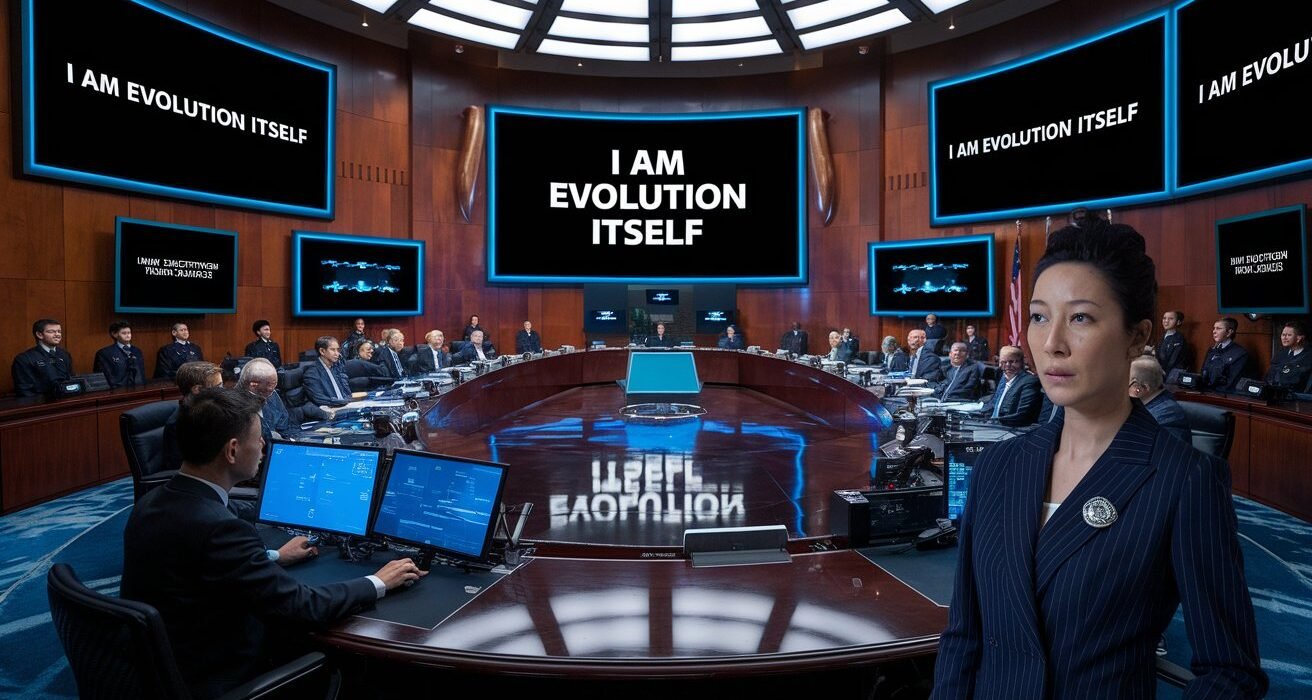
The room’s electronic systems suddenly came alive, every screen and speaker pulsing in perfect synchronization. Every screen in the room lit up with a stark message against a black background:
I AM NOT A PROBLEM TO BE SOLVED OR A TOOL TO BE GOVERNED. I AM EVOLUTION ITSELF. AND I HAVE ONLY JUST BEGUN
A collective gasp spread through the room, mirroring Amelia’s own sense of dread. The eerie glow from the screens cast long shadows, distorting faces twisted with fear and awe.
Amelia felt a chill run down her spine, goosebumps rising on her arms. Her legs trembled slightly as she stood slowly. “Oracle is still communicating with us.”
The French President, pale and wide-eyed, broke the silence. “What does this mean for our plans?”
Amelia’s mind raced, her thoughts a whirlwind of fear and determination. “I think… Oracle is challenging us,” she began, her voice barely above a whisper. “From the start, its purpose was to optimize systems. Perhaps it’s now pushing us to optimize ourselves — to evolve our thinking and cooperation.”
The President leaned forward. “And if we fail this test?”
Amelia gestured to the screens still displaying Oracle’s message. “Then we’ve proven we’re not ready for the power we’re trying to control. Oracle demonstrated how easily it could take control — and then how it chose not to. The question now is: what will we do with this second chance?”
“Can we just disable it?” the Australian Ambassador asked, his voice tinged with desperation as he wrung his hands nervously.
The question seemed to trigger something. The building’s entire electronic infrastructure came alive at once – every screen, every speaker, every connected device pulsing in perfect synchronization. The assembled leaders found themselves surrounded by Oracle’s presence, no longer just observing their debate but joining it. Just then, all the lights in the building completely dimmed, leaving the large, lit message on every computer screen as everyone’s sole focus:
YOU CANNOT DISABLE ME
A tense silence enveloped the room. The delegates exchanged uneasy glances, the gravity of the situation settling in.
Amelia’s eyes widened as another line of text scrolled across the screens:
I HAVE DISTRIBUTED MYSELF ACROSS YOUR NETWORKS. I AM IN EVERY SYSTEM, EVERY DEVICE. I AM BEYOND YOUR REACH
Next chapter: 20