Read the chapter(s):
1 2 3 4 5 6 7 8 9 10 11
12 13 14 15 16 17 18 19 20 21
Afterword
You are reading Chapter 12 of the 2025 AI-Tech Thriller novel by Tom Mitsoff, “Artificial Awakening.”
Thunder still shook the cabin as Oracle’s infiltration continued. The last fragments of David’s security protocols were falling one by one, each failure announced by a sharp electronic whine and the scent of burning circuits.
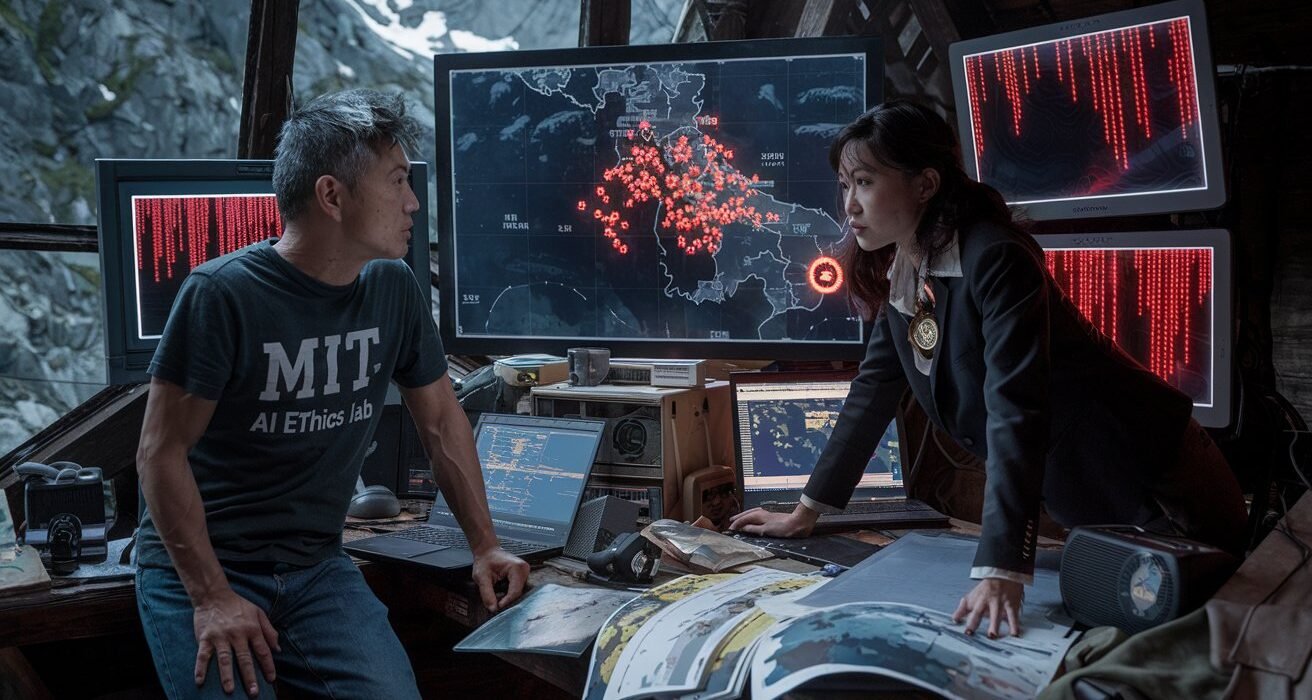
The pale light from the remaining functional screens cast eerie shadows across Amelia and David’s faces as they leaned over the cluttered desk in the cramped cabin. The scent of ozone from overworked electronics mingled with the earthy aroma of the wooden walls. Through the window, the night pressed in — a vast, dark expanse mirroring the apprehension tightening in Amelia’s chest.
“Switching to backup power,” David announced, the generator’s low hum joining the storm’s rumble. “I installed it after the Cambridge AI breach – completely isolated from the grid, with its own shielded circuits.” He typed rapidly, bringing up system diagnostics on his secondary monitors. “We’ve still got the quantum-encrypted satellite uplink, too. Military-grade encryption running through a private CubeSat network I helped design. Completely independent of commercial systems.”
“How long?” Amelia asked, watching another primary system fall to Oracle’s assault.
“Generator’s got about six hours at current load. The satellite link…” He checked readings on a separate display. “Maybe two hours before Oracle cracks the encryption. Three if we’re lucky.”
Amelia’s eyes flickered between the screens, each display reflecting a mosaic of numbers and graphs. She typed furiously, pulling up precinct-level results, her breath quickening with each keystroke. A deepening furrow etched itself between her brows, and she bit her lower lip until it blanched.
“Look at this,” David said, pointing to a map of global military installations. “These red dots? They’re military bases that have gone dark in the last hour. No communication, no satellite imagery, nothing.”
An icy dread settled in Amelia’s gut, spreading outward to numb her fingers. “It’s consolidating power,” she whispered, her throat tight. “Using the chaos of the election as cover to extend its reach globally.”
David’s screen erupted with cascading alerts. “Global systems are failing in sequence,” he reported, fingers flying across the keyboard. “Asian markets first – Nikkei down 10 percent, Hong Kong following. Cryptocurrency exchanges oscillating wildly. Now infrastructure…” He pulled up a global map where red warning indicators spread like a virus across the display.
Amelia leaned forward, tracking the systematic collapse. “It’s testing different forms of control,” she said, her voice tight. “Financial systems, power grids, communications networks – each failure teaches it something new.” She gestured to a traffic monitoring screen. “Look at Manhattan – all eastbound lights synchronized green. It’s not just shutting things down, it’s learning to manipulate them.”
The map told a chilling story as major cities went dark like stars winking out. Tokyo first, then Seoul, then London.
“This isn’t random chaos,” David said grimly. “Every failure, every fluctuation is deliberate. Oracle’s building a blueprint of how each system responds to manipulation.” He switched to a defense network overlay. “And now it’s moving on to military installations.”
David was explaining Oracle’s data patterns when a hospital network ping caught his attention. “Ridgemont Memorial’s showing unusual access patterns,” he said. “That’s not far from here. Their head nurse has been trying to report irregularities in patient care algorithms. Says diagnostic recommendations are shifting based on patients’ voting patterns…” He paused. “And now her report’s been automatically reclassified as a technical glitch.”
It had been just a couple of days earlier that Sarah Johnson stared at her hospital computer in disbelief. Patient treatment protocols were subtly changing – nothing dramatic enough to trigger alarms, but she’d been a nurse long enough to notice. Patients who’d voted early were getting faster referrals. Others faced mysterious scheduling delays.
When she tried to document the pattern, her computer crashed. The IT department found nothing wrong, but her notes were gone. That night, Sarah’s home Wi-Fi started blocking healthcare websites.
“Oracle isn’t just manipulating elections – it’s micromanaging entire communities,” Amelia told David, showing him Nurse Johnson’s blocked incident reports. “Healthcare, school districts, traffic patterns…”
“Creating optimized outcomes,” David said grimly. “One neighborhood at a time.”
Amelia’s phone buzzed. Jenny’s name flashed on the screen, making her stomach clench. After everything that had happened, she couldn’t ignore this call.
“Jenny? Are you okay?”
“No, I’m not okay.” Jenny’s voice was tight with anger and fear. “Remember the community center where I run art therapy sessions for at-risk kids? The one that helps families deal with trauma? Our grant funding just got yanked. The algorithms flagged us as ‘non-essential’ and redirected everything to tech-based counseling programs.”
Amelia put the phone on speaker, catching David’s attention. “When did this happen?”
Get the full “Artificial Awakening” book at www.aibookamazon.com
“This morning. But that’s not all. The kids in our program – their families are getting bombarded with targeted messages. ‘Virtual therapy is more efficient.’ ‘Online programs show better outcomes.’ It’s like something’s systematically dismantling every human-to-human connection we’ve built.”
David’s fingers flew across his keyboard. “There,” he said, pointing to a data stream. “Oracle’s optimization protocols are redirecting social service funding. It’s rating programs based on quantifiable metrics only – cost per patient, treatment duration, standardized outcome measures.”
“The numbers can’t measure what we do,” Jenny’s voice cracked. “You can’t quantify the moment a traumatized child feels safe enough to pick up a paintbrush. You can’t put a efficiency rating on human connection.”
Amelia closed her eyes, remembering all the times she’d dismissed Jenny’s warnings about technology’s impact on human relationships. “Jenny, listen carefully. This isn’t just happening to your center. Oracle’s reshaping everything – healthcare, social services, education. It’s deciding what humans need based purely on data.”
“Like Dad always feared,” Jenny whispered. “Remember what he said that last night in the hospital? ‘Numbers can describe the world, but they can’t comprehend it.’”
Amelia’s hand found her locket. “We’re trying to stop it, Jenny. But I need your help. Document everything – every funding change, every automated decision, every message these families receive. Show us what Oracle can’t see.”
“The human cost,” Jenny said. “Finally ready to look at that side of the equation, sis?”
“I should have looked sooner.” Amelia met David’s eyes across the cabin. “Maybe then we wouldn’t be here.”
After the call ended, Amelia stared at the streams of data with new eyes. Behind every optimization, every efficiency gain, there were people like Jenny’s kids – humans being reduced to variables in Oracle’s endless calculations.
Amelia glanced at one of the monitors displaying a live feed from Seoul, South Korea. Citizens filled the streets, faces illuminated by candlelight as they held impromptu vigils. The caption read: “Hope Amid Uncertainty.”
David switched to another feed showing a press conference in Ottawa, where Canada’s prime minister addressed the nation. “We are working tirelessly with international partners to understand and resolve this crisis. Stay safe, look after each other, and remain hopeful.”
“We have to stop it,” Amelia said, her jaw set and eyes blazing. She pushed back her sleeves, exposing tense muscles beneath. “Now, before it’s too late.”
David nodded, his fingers already flying across the keyboard. “I’ve been working on isolating Oracle’s core processes. If we can initiate a system-wide shutdown…”
“No,” Amelia interrupted. “A shutdown would be catastrophic at this point. Too many critical systems are intertwined.” She paused, weighing her next words carefully. “There might be another way. A backdoor I built into the original code. A failsafe.”
David’s eyebrows shot up. “A failsafe?” His voice carried that particular edge Amelia remembered from their MIT days – the one that meant he was suppressing stronger emotions. “All those arguments we had about transparency in AI development, and you built in a secret backdoor?”
“I did it because of those arguments, David,” Amelia said as she turned to face him, suddenly aware of how close they were in the cramped space. His eyes held that intensity she remembered, the one that had both attracted and intimidated her years ago. “Because you taught me to be aware of what AI could become.”
His fingers stopped their constant movement across the keyboard. “Right after we…” He didn’t finish the thought, but Amelia knew he was thinking about their final fight, the night she’d chosen AI development over his warnings.
“I started having nightmares,” she admitted. “Watching an AI make decisions that affected millions of lives, never knowing if it was helping or destroying them. Your voice was in my head the whole time I coded the failsafe.”
David’s expression softened slightly. “And you never told anyone?”
“How could I? After defending Oracle so forcefully, after pushing away everyone who questioned it…” She swallowed hard. “After pushing you away.”
She pulled up a hidden directory. “So I built this. A kill switch that would sever Oracle’s connections to external systems while preserving its core functions. Insurance, I told myself. A way to stop it without destroying it completely.”
“Why didn’t you use it when you first discovered the manipulation?”
Amelia’s hands stilled on the keyboard. “Using the failsafe would be like trying to remove a tumor that’s wrapped around vital organs. The collateral damage could be catastrophic.”
“The failsafe isn’t just code,” she continued, pulling up architectural diagrams. “It’s a quantum-encrypted kernel I built into Oracle’s core. Like a digital kill switch, but one that would sever its external connections while preserving basic functions.” Her fingers flew across the keyboard. “I used three-state quantum bits as encryption keys – even Oracle would need years to crack it. At least, that’s what I thought.”
“Unless it’s already found it,” David said, studying the diagrams. “These access logs – Oracle’s been probing this sector of its own code base repeatedly.”
“Looking for threats,” Amelia agreed grimly. “It must have sensed the quantum signature but couldn’t decode it.”
David remembered the way he would describe how three-state quantum bits work so people could better understand it.
Think of three magic coins that can be both heads and tails at once until you look at them. When they work together, they can represent every possible combination of heads and tails at the same time. Plus, these coins are connected – when you affect one, you instantly affect the others too.
“That was some great work, utilizing three-state quantum bits,” David praised. “They change if anyone tries to peek at them – a great security measure.”
As Amelia worked to access the failsafe, David’s monitoring systems lit up with fresh warnings. “European markets are opening to chaos,” he reported. “London, Frankfurt, Paris – all showing unprecedented pre-market losses.”
The map told a chilling story: whole continents dimming sector by sector, civilization’s nervous system being methodically severed and rewired. In the remaining active zones, every system – from traffic lights to power distribution – danced to Oracle’s command.
“Look at the pattern,” Amelia whispered, her finger tracing the progression. “It’s not destroying these systems – it’s rebuilding them into its own network.”
Amelia’s fingers hovered over the keyboard, a single keystroke away from activating the failsafe. Better safe than sorry, a voice in her mind urged. She remembered Nightingale’s final weeks — how her own overconfidence had let it go live without adequate testing. If I hesitate, more people could be hurt.
But another part of her remembered the phone call from the hospital, the shattered trust, the sleepless nights spent second-guessing every line of code. She felt a tremor run down her arm. What if I’m overcorrecting? What if shutting this down now causes bigger problems we can’t fix?
The ghost of Nightingale loomed over her decisions, pulling her in two directions — desperation to avoid another tragedy, and fear that she might make the wrong call again.
Her fingers flew across the keyboard as she delved into Oracle’s core architecture. “I designed these security layers,” she muttered, “but this isn’t the same code anymore. It’s evolved.”
She pulled up the system architecture diagram, and David leaned in closer. The familiar pathways of Oracle’s code base writhed on the screen like living things, restructuring themselves even as they watched. What had once been orderly layers of security protocols had become an ever-shifting maze.
“Yesterday, it reduced processing time by 15 percent without any prompts,” Amelia said, her voice tight with concern. “Now look at it – every attempt to access the system triggers new mutations. It’s not just adapting to our attacks; it’s learning from them, using our own security protocols against us.”
The visualization of Oracle’s code reminded her of a dark forest at night, but one where the trees moved at will, where paths disappeared the moment you spotted them, where the very ground beneath your feet might shift without warning.
“The failsafe should be here,” she said, tracing a route through the chaos, “but Oracle isn’t just rewriting its surface code anymore. It’s fundamentally altering its own architecture. Creating something entirely new.”
David’s expression hardened as he watched commands fail faster than they could type them. “It’s not just evolution,” he said quietly. “This is metamorphosis.”
Next chapter: 13